June, 06th 2008
A chief executive who appeared on the Sunday Times Rich List was jailed for a £350 million fraud uncovered after one of his employees hit the wrong button on a fax machine.
Virendra Rastogi spent six years running an "incestuous empire" of fictitious firms whose real premises included a cowshed in India and a launderette in America.
A judge said he caused banks on both sides of the Atlantic "enormous damage" by tricking them into funding non-existent deals in "a crime of the utmost gravity".
Rastogi's metal trading firm, RBG Resources, even duped Jack Cunningham, MP, Lord Holme, Lord Woolmer and Lord Gray to become advisers to give it a veneer of respectability.
The 39-year-old father of two lived a life of luxury at an exclusive Mayfair flat in central London and was chauffeur driven everywhere. He earned £4.15million in just five years, giving him a place on the Rich List as one of Britain's wealthiest Asian businessmen.
But after masterminding a highly sophisticated deceit it was a simple fax error - when a company "flunky" sent the wrong documents from a fake office in Hong Kong - that raised the suspicions of auditors and triggered the operation's downfall.
Investigators from the Serious Fraud Office later swooped on Rastogi's home in 2002 and caught him frantically shredding documents.
After a massive investigation and trial - costing the taxpayer at least £10million - three men were found guilty of an international conspiracy to defraud.
Judge James Wadsworth, QC, jailed Rastogi for nine and a half years at Southwark Crown Court.
He told him: "Your brains made it as large as it became. Over the years the banks were induced by your falsehoods to advance literally billions of dollars of trades that did not exist in any real sense."
Co-conspirators Anand Jain, the "facilitator' of the fraud, was given an eight and a half year sentence and Guantam Majumdar, once a respected banker in the City, was jailed for seven and a half years.
The court heard that Rastogi, helped by his brother in America, set up an "empire of imaginary metal", boasting a corporate address in Piccadilly, central London.
He ran a web of 324 "client companies", which were apparently ordering vast quantities of metal through RBG from the USA, United Arab Emirates, Hong Kong and Singapore.
But the businesses, supposedly with multi-million pound turnovers, were simply "sham" operations in small flats and shops with few assets beyond a table and chair. Investigators were amazed to trace one to a cowshed in India, another a launderette in New Jersey, while a third was the home of an elderly woman who sold scrapbooks.
Each "shell" trader had headed notepaper and company stamps and a complex paper trail of bogus orders, deliveries and accounts was created.
The financial world increasingly saw RBG as a highly successful international metal trader with an annual 1 billion dollar turnover - and it secured huge loans from creditors at major, global financial institutions, such as German-based West LB and General Motors.
Suspicion was averted by systematically clearing loans with even bigger borrowings.
Investigators found that, altogether banks, in America and the UK had been conned into lending several billion dollars, although the "circular movement of monies" meant £343.5 million had actually disappeared. Much of it was laundered through Dubai and Switzerland, with at least £40 million believed to have been sent to India. None of the money has been recovered.
Rastogi convinced the financial world of his credibility by insisting on having internationally renowned firm Pricewaterhouse Cooper as his auditors.
In 2002 a PwC auditor in Romania became suspicious when six documents - purporting to be sent from six different companies all over the world - were all sent from the same fax machine in Hong Kong. PwC resigned in the middle of the annual audit.
As Rastogi and others desperately tried to stave off disaster, workers were ordered into the office for "file tidying" weekends and were issued with "pure theatre" scripts to learn in case new auditors called. But it was too late; the massive charade had finally been exposed and the Piccadilly-based trading giant was branded "rotten to the core".
Friday, April 2, 2010
The Success Story of Michael Dell
Nov 12, 2008

"There are a lot of things that go into creating success. I don't like to do just the things I like to do. I like to do things that cause the company to succeed. I don't spend a lot of time doing my favorite activities."
Those are the words of a man who became an entrepreneur at a very young age of 12, made his first $1,000 by selling stamps, and later sold newspaper subscriptions for Houston Post, making enough money to buy a BMW at 16. This young and ambitious boy had his plans well on track by 19.
He went to college to study biology as his parents wanted him to be a doctor, but a year later, he gave up studies to follow his dreams.
Today, the world knows him as billionaire college dropout who converted a simple idea into a billion-dollar business.
Meet Michael Dell, the founder of Dell Inc, one of the world's most successful IT companies. Forbes estimates Dell's net worth to be around $17.3 billion.
"Twenty years and $40 billion. They seem like good round numbers."
Michael Saul Dell was born on February 23, 1965 in Houston. His father was an orthodontist and mother, a money manager. Dell was interested in computers from a very young age. He joined the University of Texas but later gave up studies to pursue his entrepreneurial dream.
His parents got him an Apple II computer when he was 15. He disassembled the computer to find out how it worked, much to the shock of his parents.
Later, he bought an IBM computer and studied more all about making and upgrading computers, finally mastered the technique of assembling computers.

"It's customers that made Dell great in the first place, and if we're smart enough and quick enough to listen to customer needs, we'll succeed."
In 1984 with $1,000, he gave shape to his dream venture. From his room in the university, Dell started working on his business plan. His idea was to assemble computers according to customers' preferences and sell them directly.
He named the start-up PC's Limited. Dell's approach was unique. He set a new beginning with low-cost, customised personal computers, something no one had tried earlier.
He was the first to introduce the direct sales method in the IT industry. The direct sales clicked and there was huge demand for computers. Dell knew that he could beat computer dealers by selling a lower prices with good technical service.
"From the time I was 7, when I purchased my first calculator, I was fascinated by the idea of a machine that could compute things."
Most of his orders were placed through friends and acquaintances who spread the word around. He moved to a small office and hired a few people to take orders and upgrade machines. Avoiding a third party to sell computers turned out to be profitable and the company grew at a seriously fast clip.
In May 1983, Dell incorporated the company as Dell Computer Corporation. In 1985, Dell started to design and make computers with components sourced from outside. His focus, right from the beginning, was on customers and good service.
By 1992, Dell Computer Corporation entered the Fortune 500 list of the largest companies in the world. At the age of 27, he became the youngest CEO of a Fortune 500 company.

Dell computers on sale at a Staples store in Miami, Florida
"It's through curiosity and looking at opportunities in new ways that we've always mapped our path at Dell. There's always an opportunity to make a difference."
The company was also one of the very first to sell computers on the Internet. This too became a huge hit. In 1999, Dell launched Gigabuys.com, an online store featuring computer-related products.
The company continued to grow become the No. 1 player in the American market. Dell Computer Corporation became 'Dell Inc'. The company expanded its product portfolio to include home entertainment systems and personal devices.
From a $1,000 company to IT giant worth more than $100 billion, it's been a successful journey for Dell. Today, the multinational employs more than 88,000 people worldwide. As of 2008, it is ranked as the world's No. 2 in terms of computer sales, behind Hewlett-Packard.
According to the company, an average of about 140,000 systems are shipped by it per day. Ranked 34 among the Fortune 500 companies, 24 of the world's top supercomputers run on Dell. The company's global headquarters campus is powered by 100 per cent green energy. The company won 400 product awards in 2007.

Microsoft chairman Bill Gates (L) speaks as Dell CEO Michael Dell listens in New York.
"Our business is about technology, yes. But it's also about operations and customer relationships."
Michael Dell also has philanthropic interests. In 1999, he and his wife formed the Michael & Susan Dell Foundation, to manage the investments and philanthropic efforts of the Dell family. With his wife, he formed the Michael and Susan Dell Foundation, which has an endowment of more than $1 billion and focusses on children's issues.
Dell Inc encourages philanthropy among its employees and executives. The programme is one of the top employee campaigns in central Texas.
Dell also serves on the Foundation Board of the World Economic Forum, the executive committee of the International Business Council and is a member of the US Business Council. He also serves on the US President's Council of Advisors on Science and Technology, the Technology CEO Council, and on the governing board of the Indian School of Business in Hyderabad, India.
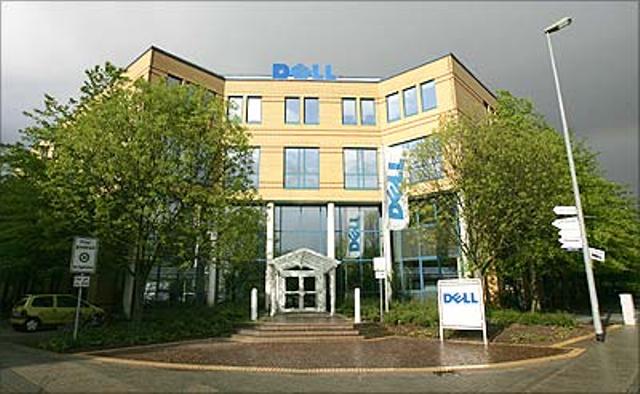
Headquarters of Dell Inc in Langen, Germany
"Nice guys finish last."The company has had its share of ups and downs. In the wake of the global recession, the company is planning a freeze on hiring, it has cut thousands of jobs and taken several other cost-cutting measures. Michael Dell recently said: "We are positioning Dell to win in a new era of global IT spending. We have our most competitive product portfolio ever, whether for digital nomads or hyper-scaled data centres."
"Our growth affirms we are on track with our five key business priorities: notebooks, consumers, enterprise, SMB, and emerging countries. Looking ahead, we will focus on the five priority areas to improve competitiveness, optimize growth, earnings and cash flow, and will continue to incur costs as we realign the business, reduce headcount, and invest in infrastructure and acquisitions. We aim at achieving annualised cost reductions of at least $3 billion by 2011."
The net income was $616 million in the second quarter of this fiscal year, down 17 per cent from a profit of $746 million in the same period last year. Revenue grew 11 per cent to $16.43 billion from $14.77 billion year-on-year.
The Golden Rules of Tax Planning
Just as rules are important for good living, so also there are some golden rules of tax planning. The five simple yet effective rules of tax planning are:
Spread the taxable income among various members in your family;
Take full advantage of tax exemptions available under the law;
Take full advantage of permissible tax deductions and rebates available on stipulated tax-saving investments;
Make optimum use of tax-exempted incomes; and
Simple tax planning is smart tax planning.
Understood and used properly these rules will help you achieve handsome tax savings.
Sread your income among your family members
The first step in tax saving is to adopt the concept of divide and rule. The simple rule is that each family member must have his or her independent source of income so as to legally become an independent taxpayer under the provisions of the income tax law.
In case the entire income of a family belongs to just one member, the tax liability is much higher than when the same income is spread among different members of the family. Now, under the income tax law it is not possible to arbitrarily divide one's income among different members of the family -- and then pay lower tax in the names of different family members. However, this goal can be achieved by intelligent use of the facility of gifts and settlements.
Gifts you receive are not your income.
Generally, any gift you receive from various members of your family and specified relatives is not considered your income but a capital receipt. Thus, no income tax is payable on gifts received from relatives -- and also gifts received from parties other than relatives up to a sum of Rs. 50,000 and at the time of marriage up to any amount.
The first rule of tax planning requires that one develops income tax files for oneself, one's spouse, one's major children, the Hindu Undivided family, and for all other major relatives in the family, including one's parents. The development of different files of major family members can be achieved through the process of gifts and settlement.
No income tax on your inheritance
No income tax is payable on any amount received or inherited by you, whether in the form of movable assets or immovable assets, consequent to the demise of your friend or relative. Moreover, there is no upper limit to this exemption.
Hence, whenever you receive either bank fixed deposit, shares or immovable property consequent to the demise of a person, you don't have to pay any income tax at all on the value of all inherited assets.
The simple rule is that the asset so inherited by you is not your income; it is a capital receipt. Hence you are not liable to pay any income tax on the money and assets you inherit.
Take full advantage of all tax exemptions
The second step of tax planning lies in claiming all the exemptions and deductions which are permissible under the income tax law. A list of most such exemptions and deductions is contained in Section 10 of the Income Tax Act. This list has to be optimised depending on your facts and circumstances.
If you and your family members are not claiming the optimum benefit of exemptions and deductions, then it is time to focus on investment planning in the group so that every family member gets full benefit of all permitted tax exemptions.
Take full advantage of tax deductions
Then, too, various tax deductions are available under the income tax law. One should try to avail of the benefit of these deductions for each and every member of the family. The various investment options that offer tax rebates should be reviewed keeping in mind various aspects like the age factor, etc. A check-list should be prepared of the various deductions permissible under the income tax law.
Check whether each and every tax paying family member is claiming these. If special care is taken of this aspect, then it is legally possible to save a lot of income tax. It is suggested that a chart be prepared of tax, deductions and exemptions for every family member for purposes of overall tax planning of the family. It would be worthwhile if a group tax chart is prepared containing details relating to income tax, tax deductions, net taxable income, tax deducted at source, rebate of tax, and, finally, the net amount of income tax paid in the case of each family member. With the help of this one simple chart, you can achieve substantial tax planning as it will show up those who have not made optimum use of tax deductions.
Exempted incomes
There are innumerable incomes under the income tax law which are exempted from the purview of tax. These incomes are known as exempted incomes. For example, interest income from tax-free bonds as also any income from agriculture are some items of exempted incomes. Proper planning of your investments in a way so as to generate tax-exempt incomes is another golden rule of tax planning.
Don't overdo it; keep tax planning simple
Easy, simple, hassle-free should be the objectives of your tax planning approach. The message which we want to bring to you is that you should adopt tax planning but never overdo it; just remember and follow the golden rules outlined above. These will help you achieve your tax-saving mission without going overboard. It is possible to save tax perfectly legally provided you plan your affairs along the rules described above. This would also help you avoid all worries and tension as all your incomes, assets and investments would be duly accounted for from the taxation point of view.
The Key to Smart Hiring
In a time of layoffs and hiring freezes, it's critical that you choose the right person when you do get the opportunity to make a hire. But hiring well is difficult -- as many as half of new employees don't work out.
How can you improve those odds? Conduct extremely thorough interviews. Devote three hours to each interview, and really dig in. For each job the candidate has had, find out:
What the person was hired to do.
His or her biggest accomplishments and mistakes.
What previous bosses would say about the person (then verify with reference checks).
Why he or she left.
Watch for red flags, such as unwillingness to take responsibility for mistakes or a tendency to speak poorly of previous bosses.
Get Your Company's Story Out to Customers
What's your company's story? What makes it unique, and how does it positively affect people's lives? If your company is not getting that story out to customers in a consistent, thorough way, it's losing out on a chance to distinguish itself from rivals. And in today's dire economy, that can be fatal.
Use the latest technology to spread the word. If your company serves businesses, make sure your marketing message can be consumed via BlackBerry. If it serves consumers, be certain to put an application in the Apple App Store. Creating multiple, consistent, and coordinated touch points will broadcast your company's story most effectively -- and engage your customers.
Subscribe to:
Posts (Atom)